Most B2B companies still treat SEO like a checklist. Publish a blog, sprinkle in some keywords, wait for traffic. That approach worked a decade ago. It doesn’t anymore.
Working with an ai seo agency today means something different than it did even two years ago. Search itself has changed. Google’s AI Overviews summarize answers before anyone clicks a link. ChatGPT and Perplexity are becoming research tools in their own right. And ranking on page one no longer guarantees visibility, let alone traffic.
So what actually works? Let’s break it down.
Why Traditional SEO Tactics Are Losing Steam
Here’s the thing: keyword stuffing and backlink farms were never sustainable. They just took longer to fail. Search engines have gotten better at spotting thin, formulaic content, and readers have gotten better at ignoring it.
That’s exactly why good SEO Services look so different today than they did a few years back. The businesses still winning organic traffic in 2026 share a pattern. They treat SEO as a long-term system, not a quarterly campaign. That means:
- Building topical authority instead of chasing one-off keywords.
- Producing content that answers real questions, not just ranks for them.
- Structuring pages so both humans and AI models can parse and cite them.
Honestly, that last point matters more than most teams realize right now.
What an AI SEO Agency Actually Does Differently
A modern SEO agency doesn’t start with keywords. It starts with intent. Who’s searching, what are they actually trying to solve, and where are they in their buying journey?
From there, the work usually breaks into three connected layers.
Technical Foundations
If your site loads slowly, has broken schema, or confuses crawlers, none of the content work matters. Technical SEO is the plumbing. Nobody notices it when it works, and everyone notices when it doesn’t.
Content That Earns Rankings
Building content clusters around topics your buyers actually care about does two things at once: it signals topical depth to search engines, and it gives sales teams material that actually helps close deals.
Why an AI SEO Agency Focuses Here
Getting cited by ChatGPT or Google’s AI Overviews isn’t magic. It comes down to clear structure, direct answers, and content that’s genuinely citation-worthy. If your answer is buried in fluff, an AI model will skip it for a competitor’s clearer one.
Quick summary: Modern SEO isn’t one tactic. It’s technical health, intent-driven content, and structure that both search engines and AI models can parse and cite.
How Do You Know If Your SEO Strategy Is Actually Working?
A lot of teams measure the wrong things. Rankings for vanity keywords look nice in a report, but they don’t pay the bills.
Better questions to ask:
- Is organic traffic converting into pipeline, not just page views?
- Are you showing up for the questions your ideal customers are actually asking?
- Is your content getting referenced by AI search tools, or just sitting on page three of Google?
To be completely fair, most companies don’t track any of this well. That’s usually the real gap, not the content itself.
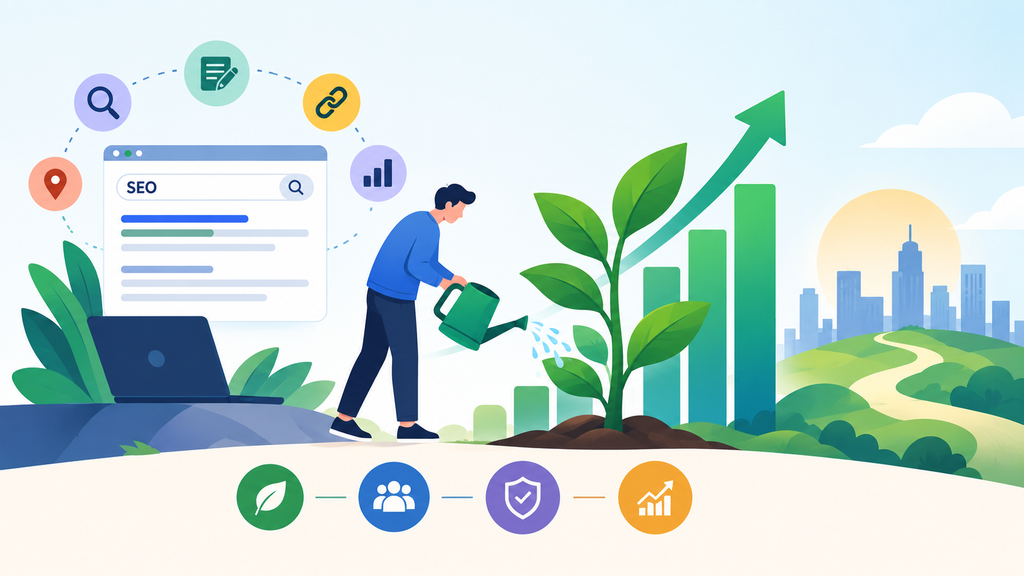
Building an Organic Growth Engine, Not a One-Time Win
Picture this: two companies both invest in SEO for six months. One sees a traffic spike, then a plateau. The other sees steady, compounding growth well past month twelve.
The difference usually comes down to system versus sprint. A one-time content push might get you a ranking bump. But sustainable growth needs:
- A content calendar tied to buyer intent, not just search volume.
- Regular technical audits so nothing quietly breaks.
- A feedback loop between what ranks, what converts, and what gets updated.
Note: Organic growth compounds when content, technical health, and conversion tracking work together, not as three separate workstreams.
Where an AI SEO Agency Fits Into the Picture Now
Search behavior has genuinely shifted. Buyers ask ChatGPT for recommendations the same way they used to type into Google. That’s not a future trend; it’s happening now.
This doesn’t mean traditional SEO is dead. It means it’s expanding. The businesses adapting fastest are optimizing for both classic search rankings and AI-generated answers at the same time, rather than treating them as separate projects.
And believe it or not, a lot of the underlying work overlaps. Clear structure, direct answers, and well-organized content help you rank on Google and get cited by an AI model.
Common Mistakes That Stall Organic Growth
A few patterns show up again and again:
- Publishing without a strategy. Content for content’s sake rarely moves the needle.
- Ignoring technical SEO. Great content on a slow, broken site still underperforms.
- Treating SEO as a one-off project. It’s an ongoing system, not a campaign with an end date.
- Skipping AI search entirely. Buyers are already using these tools, whether your content shows up in them or not.
Important: The businesses seeing sustainable organic growth avoid these traps by treating SEO as an integrated, ongoing system rather than a series of disconnected tactics.
Getting Started Without Overhauling Everything at Once
You don’t need to rebuild your entire marketing stack overnight. Start with an audit: what’s ranking, what’s broken, and where the real content gaps are.
From there, prioritize the fixes and content pieces most likely to move revenue, not just traffic. That’s usually a mix of a few technical quick wins and two or three high-intent content pieces per month.
Take my word for it: momentum builds faster than most teams expect once the foundation is solid.
FAQs
1. What makes an SEO strategy “modern” versus traditional?
Modern SEO combines technical health, intent-driven content, and optimization for AI search tools like ChatGPT and Google AI Overviews, not just keyword rankings on traditional search results pages.
2. How long does it take to see results from organic SEO?
Most B2B companies see meaningful traffic and pipeline movement within four to six months, though compounding growth typically continues well beyond that if the strategy stays consistent.
3. Is AI search optimization different from regular SEO?
It overlaps significantly. Both reward clear structure and direct answers, but AI search optimization also focuses on citation-worthy content that models like ChatGPT can pull from directly.
4. Can small B2B companies compete with larger competitors on SEO?
Yes. Topical depth and search intent matter more than domain size. A focused content strategy in a specific niche often outperforms broad, generic content from bigger competitors.