Introduction
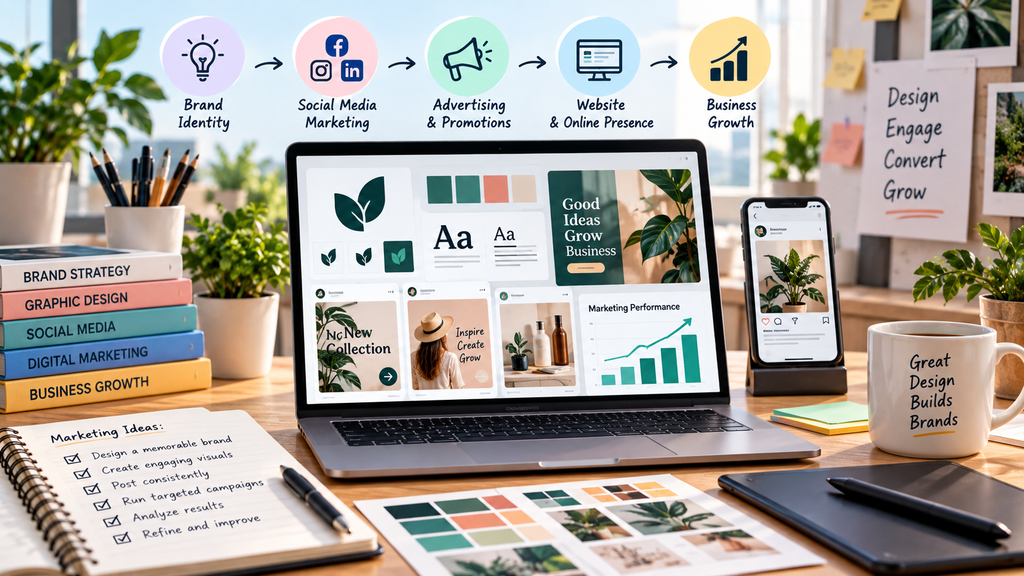
In a competitive marketplace, having a great product or service is only part of building a successful business. You also need to communicate your value, attract attention, and give potential customers a reason to remember your brand.
Graphic design can help you achieve these goals by turning your business messages into clear, engaging visuals. From your logo and website to social media posts, digital advertisements, brochures, and email campaigns, design influences how people discover and perceive your business.
However, effective graphic design is about more than creating attractive images. Every visual should serve a purpose, whether it is building brand awareness, explaining a product, generating leads, or encouraging customers to make a purchase.
In this guide, you’ll learn how to market your business using graphic design, choose the right visuals, use helpful design tools, and measure the results of your efforts.
What Is Graphic Design in Marketing?
Graphic design in marketing involves creating visual materials that communicate a brand’s message and support its business objectives.
These materials can include:
- Logos and brand identity assets.
- Social media graphics and promotional posts.
- Website banners and landing-page visuals.
- Digital advertisements and campaign creatives.
- Product packaging and promotional brochures.
- Email newsletter graphics.
- Infographics, presentations, and business reports.
- Animated graphics and short promotional visuals.
A well-designed marketing asset helps people understand your message quickly. It can highlight a product’s benefits, make information easier to digest, and guide viewers toward a specific action.
For example, a restaurant could use a promotional graphic to showcase a new menu item, while a software company might create an infographic explaining how its product solves a common business problem.
The most effective designs combine visual appeal with a clear message and a relevant call to action.
Why Is Graphic Design Important for Business Marketing?
Graphic design plays an important role in how businesses communicate with potential customers. Here are some of its main benefits.
1. Build Brand Recognition
Customers are more likely to recognize your business when they repeatedly encounter consistent visual elements.
Your logo, colors, typography, photography style, and layouts all contribute to your brand’s visual identity. Using them consistently across marketing channels makes your business easier to identify.
For example, when your website, social media posts, packaging, and advertisements share the same visual style, customers can begin associating those elements with your business.
2. Create a Professional First Impression
Potential customers may encounter your brand before they speak to your team or try your product. Your marketing materials can influence their initial perception.
Clear layouts, readable typography, high-quality images, and consistent branding can make your business appear more organized and credible.
On the other hand, cluttered graphics, inconsistent colors, and poorly formatted text can make it harder for customers to understand your offer.
3. Communicate Complex Ideas Clearly
Some products and services are difficult to explain using text alone.
Infographics, diagrams, illustrations, and comparison charts can simplify information and help customers understand key benefits.
For example, a financial services company might use a chart to explain different pricing plans, while a software business could use a diagram to demonstrate how its platform works.
4. Improve Marketing Engagement
Relevant visuals can make marketing content easier to notice and understand. They can also help you present information in formats that suit different platforms and audiences.
However, attractive graphics alone do not guarantee engagement or sales. Your content must also be useful, relevant, and appropriate for your target audience.
5. Support Conversions and Sales
Marketing design can guide potential customers toward the next step in their buying journey.
A landing page with a clear headline, a relevant product image, concise benefit statements, and a visible call-to-action button makes the offer easier to understand.
Similarly, a well-structured advertisement can communicate a product’s value and direct interested users to a relevant page.
The key is to design around the action you want your audience to take.
10 Ways to Market Your Business Using Graphic Design
1. Create a Consistent Brand Identity
Start by developing a recognizable visual identity for your business. This should reflect your company’s personality, values, audience, and market positioning.
Your brand identity should establish:
- Logo: A recognizable symbol or wordmark that represents your business.
- Color palette: A consistent set of colors used across marketing materials.
- Typography: Fonts that are readable and appropriate for your brand.
- Imagery: Photography, illustrations, and graphics that fit your brand’s style.
- Design guidelines: Rules for applying these elements consistently.
Building a well-designed brand identity gives your marketing materials a consistent foundation and helps you present a recognizable image across different channels.
Create a simple brand guide that documents your colors, fonts, logo variations, and image styles. Share it with employees, freelancers, and agencies who create content for your business.
2. Design Engaging Social Media Graphics
Social media gives businesses opportunities to reach audiences through visual content. Instead of publishing only text-based updates, use graphic design to make your messages more accessible and memorable.
Consider creating:
- Product showcases and feature highlights.
- Educational carousels and how-to graphics.
- Customer testimonials and success stories.
- Promotional offers and seasonal campaigns.
- Behind-the-scenes visuals.
- Event announcements and product launches.
- Short videos and animated posts.
Adapt each design to the platform where it will appear. Text that looks readable on a desktop may be too small on a mobile screen.
Use a few reusable templates to maintain consistency while varying the content to keep your posts relevant.
For example, an online clothing store might create product-focused posts, styling tips, seasonal collections, and customer photos using the same brand colors and typography.
3. Improve Your Website With Strategic Design
Your website should help visitors understand what your business offers and how to take the next step.
Graphic design can improve the experience by creating a clear visual hierarchy and making important information easier to find.
Focus on the following elements:
- A clear headline explaining your offer.
- Relevant product or service images.
- Consistent colors and typography.
- Easy-to-scan sections and headings.
- Visible calls to action.
- Trust signals, such as testimonials and case studies.
- Responsive layouts for mobile devices.
Avoid adding decorative elements that distract visitors from your main message. Use images that support your content, and optimize their file sizes to help pages load efficiently.
For service businesses, the website should make it easy to understand the services offered and contact the company. For ecommerce businesses, product images, pricing information, and purchase buttons should be easy to locate.
4. Create More Effective Digital Advertisements
Graphic design is a key part of visual advertising on social media, search platforms, websites, and other digital channels.
A good advertisement communicates its main message quickly. It should help the intended audience understand what is being offered and why it might be relevant to them.
An effective ad typically includes:
- A clear headline.
- One primary message or benefit.
- A relevant image or illustration.
- Readable text with sufficient contrast.
- A specific call to action.
For example, a business offering project management software might use a graphic showing a cluttered workflow alongside a more organized dashboard, supported by a headline about simplifying team collaboration.
Test different headlines, images, layouts, and calls to action to identify which combinations produce the best results. Evaluate performance using relevant metrics such as click-through rate, cost per lead, and conversions.
5. Use Infographics to Explain Your Products and Services
Infographics combine text, illustrations, charts, and other visual elements to explain information in an easy-to-follow format.
They can be useful when you want to communicate information that would otherwise require several paragraphs.
You can use infographics to:
- Explain how a product works.
- Compare service packages.
- Present research findings.
- Share industry statistics.
- Outline a step-by-step process.
- Summarize a case study.
- Answer frequently asked questions.
Keep your infographic focused on one central topic. Use clear headings, accurate information, readable text, and a logical flow.
You can publish infographics on your website, share them on social media, or include them in presentations and email campaigns.
6. Design Marketing Emails That Are Easy to Read
Email marketing remains a useful way to communicate with prospects and existing customers. Graphic design can make your emails more organized and help readers identify important information.
Useful design elements include:
- A recognizable header and logo.
- A clear subject-related headline.
- Short sections with descriptive headings.
- Product images or relevant illustrations.
- Consistent brand colors and fonts.
- Prominent but unobtrusive calls to action.
- A simple layout that works on mobile devices.
For example, an ecommerce business announcing a new collection could use a product image, a short description, and a button leading directly to the collection page.
Keep the email focused on one primary objective. Too many images, competing offers, or calls to action can make the message harder to follow.
Also provide meaningful alternative text for informative images and ensure that essential information is available as text rather than only inside graphics.
7. Use Motion Graphics and Animated Images
Static images are useful for many marketing activities, but motion can help demonstrate a product, highlight a feature, or make a campaign more dynamic.
You can use animation for:
- Product demonstrations.
- Short social media promotions.
- Animated advertisements.
- Step-by-step tutorials.
- Logo animations.
- Feature announcements.
- Event promotions.
Tools that let you animate images can help you create motion-based content from existing visuals.
For example, a fitness business could animate a sequence demonstrating an exercise, while a software company might use a short animation to show how a feature works.
Keep animations purposeful and avoid excessive movement. Make sure important information remains readable, and consider users who prefer reduced motion or may view content with sound disabled.
8. Create Branded Promotional Materials
Graphic design is also useful for offline marketing and sales activities.
Depending on your business, you might create:
- Business cards.
- Flyers and brochures.
- Product catalogs.
- Event banners.
- Packaging and labels.
- Posters and signage.
- Sales presentations.
- Branded merchandise.
These materials should communicate your offer clearly and reflect the same visual identity used across your digital channels.
If you are promoting a physical store, for example, consistent signage, promotional posters, and product labels can help customers identify your brand.
Before printing, review the design dimensions, image resolution, color settings, margins, and readability at the intended viewing distance.
9. Work With a Professional Graphic Designer or Branding Agency
Some businesses can manage basic graphics internally, while others need professional support for branding, campaign development, packaging, or complex marketing materials.
Consider working with a designer or agency when you need a more distinctive brand identity, a website redesign, a coordinated advertising campaign, or design assets across several channels.
If you are targeting the UAE market, a branding agency in Dubai may be an option to evaluate for branding and creative support.
Before choosing a provider, review its portfolio, relevant industry experience, creative process, pricing, and revision policy. Ask how it will understand your audience and business goals before recommending a visual direction.
A professional designer should do more than make graphics look attractive. The work should communicate your brand’s value and support your marketing objectives.
10. Use AI Tools to Support Your Design Workflow
AI-powered tools can help marketers organize information, explore creative concepts, and streamline parts of the content production process.
For example, you can use AI to brainstorm campaign ideas, outline infographic content, draft social media captions, summarize survey findings, or develop alternative headlines for an advertisement.
Julius AI can help users analyze data and generate insights that may inform marketing decisions. For instance, you could analyze campaign performance data to identify patterns and then use those findings to guide your next set of graphics.
Other design tools can help with layout creation, image editing, template customization, and animation.
AI should support the creative process rather than replace human judgment. Check generated information for accuracy, ensure that visuals fit your brand, and review licensing, privacy, and usage terms before publishing.
How to Build a Graphic Design Marketing Strategy
Creating individual graphics is useful, but a planned approach makes it easier to connect design activities with business goals.
Step 1: Understand Your Target Audience
Identify who you want to reach, what problems they face, and what information they need before making a purchase.
Consider their preferences, buying behavior, industry, and the platforms they use.
A graphic designed for business executives may need a different tone and structure from one intended for younger consumers.
Step 2: Set a Clear Marketing Objective
Determine what each design should accomplish.
For example:
- Brand awareness: Make your business more recognizable.
- Engagement: Encourage meaningful interactions.
- Website traffic: Get people to visit a specific page.
- Lead generation: Encourage prospects to request information.
- Sales: Help customers understand an offer and purchase.
A design should have one main objective so you can evaluate whether it is working.
Step 3: Choose the Right Format and Channel
Match the visual format to the message and the platform.
An infographic may work well for educational content, while a short animated visual may be better for demonstrating a product feature. A brochure may be appropriate for an in-person sales meeting, while a simple promotional graphic could support a social media campaign.
Adapt dimensions and layouts to each channel rather than stretching one design across every format.
Step 4: Create a Content and Design Calendar
Plan your upcoming visual content so that you can maintain a consistent publishing schedule.
A simple monthly calendar might include:
- Week 1: Brand introduction and educational content.
- Week 2: Product benefits and customer questions.
- Week 3: Testimonials and case studies.
- Week 4: Promotional campaign and performance review.
Adjust this schedule based on your audience, resources, and marketing goals.
Step 5: Measure Performance and Improve
Track the metrics that match your objectives.
| Marketing Objective | Useful Metrics |
|---|---|
| Brand awareness | Reach, impressions, branded searches |
| Social media engagement | Comments, shares, saves, engagement rate |
| Website traffic | Sessions, click-through rate, referral traffic |
| Lead generation | Form submissions, qualified leads, cost per lead |
| Sales | Conversion rate, revenue, return on ad spend |
| Email marketing | Click-through rate, conversions, unsubscribe rate |
Use the data to identify which designs, messages, and formats perform best. Test one or two meaningful changes at a time when possible, so you can better understand what influenced the result.
Remember that design is only one factor in marketing performance. Audience targeting, offer quality, pricing, timing, copywriting, and the landing-page experience also affect outcomes.
Common Graphic Design Marketing Mistakes to Avoid
Even visually attractive marketing materials can be ineffective if they fail to communicate the intended message.
Using Too Many Colors and Fonts
A large variety of colors and typefaces can make your graphics look inconsistent. Choose a limited palette and a small set of complementary fonts.
Adding Too Much Text
Customers should be able to identify the main message quickly. Remove unnecessary wording and use headings, spacing, and visual hierarchy to guide attention.
Ignoring Mobile Users
Many people encounter marketing content on mobile devices. Check that text is readable, buttons are accessible, and important visual elements remain clear on smaller screens.
Focusing on Appearance Instead of Purpose
A design may look impressive without encouraging the intended action. Make sure it communicates a clear benefit and supports the campaign’s objective.
Using Low-Quality or Irrelevant Images
Blurry, generic, or misleading images can weaken your message. Choose visuals that accurately represent your product, service, or brand.
Inconsistent Branding
Changing your visual style across every post can make your business harder to recognize. Use brand guidelines and templates to maintain consistency.
Failing to Test Results
Don’t assume that the most attractive design will perform best. Compare variations and use actual campaign data to guide future decisions.
Frequently Asked Questions
How can graphic design help market a small business?
Graphic design helps small businesses create a recognizable brand, explain their products, promote offers, and communicate professionally across digital and offline channels. Businesses can begin with a simple brand guide and a few reusable templates.
Do I need a professional designer to market my business?
Not necessarily. You can create simple social media posts, flyers, and promotional graphics using templates and beginner-friendly tools. Professional support may be worthwhile when you need a complete brand identity, complex designs, or a coordinated campaign.
Which graphic design elements are most important for branding?
The main elements include your logo, color palette, typography, imagery, layout, and brand guidelines. Together, they create a visual system that helps customers recognize your business.
How often should I publish graphic design content on social media?
There is no universal publishing frequency. Choose a schedule your team can maintain while producing useful, high-quality content. Monitor engagement and other relevant metrics to determine whether your frequency and content mix are effective.
Can AI help with graphic design marketing?
Yes. AI tools can support brainstorming, data analysis, content planning, and parts of the creative workflow. However, you should review generated outputs for accuracy, originality, brand consistency, and suitability before publishing.
How do I measure the ROI of graphic design in marketing?
Compare the costs of creating and distributing your design assets with the outcomes they help generate. Depending on the campaign, you might measure leads, sales, conversion rates, cost per acquisition, or return on ad spend. For brand awareness campaigns, use appropriate reach and recognition indicators while recognizing that their business impact may take longer to measure.
Conclusion
Graphic design can help you market your business by making your brand more recognizable, communicating your value clearly, and supporting campaigns across digital and offline channels.
Start by establishing a consistent brand identity. Then apply it to your website, social media content, digital advertisements, emails, and promotional materials. Use animation, infographics, professional design support, and AI tools where they genuinely improve your workflow.
Most importantly, connect every design to a marketing objective. Track performance, learn what resonates with your audience, and refine your approach over time.
When visual creativity is combined with a clear message and a measurable goal, graphic design becomes more than decoration—it becomes a practical part of your business marketing strategy.