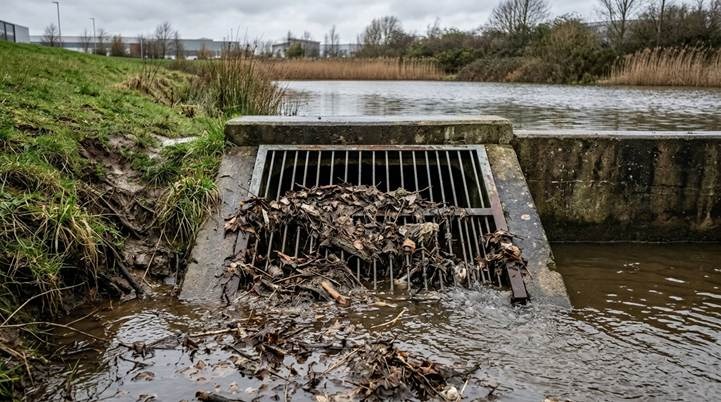
A blocked outlet structure is a common point of failure that can lead to flooding and erosion.
By a pond and water systems industry contributor.
A pond that looks fine from a distance can hide big problems. An overgrown shoreline, slow draining after a storm, or cloudy water are often early warning signs. If ignored, these small issues can lead to clogged pipes, shoreline erosion, and fines from local authorities. The cause is usually a buildup of dirt and nutrients that throws the pond’s natural system off balance.
This is more than just an issue of appearance; it’s an environmental one. According to the US EPA, pollution from nutrients like nitrogen and phosphorus is a major concern, affecting nearly 20% of lakes in a national study. Your retention pond is a small version of this system, built to catch and filter runoff. If it is not maintained correctly, it can’t do its job. This can lead to expensive cleaning projects or even fines. Understanding professional pond maintenance services is the first step to managing these risks. The goal is to prevent problems instead of just fixing them, which keeps the system healthy and legal.
Quick answer: Choosing a pond maintenance company involves more than comparing prices for algae removal. You should check their experience with sediment, their methods for waste disposal, and their knowledge of local storm water rules. A qualified partner focuses on the long-term health of the pond as a working system, not just how it looks on the surface.
What’s inside
· What Are the Real Costs of Delaying Pond Maintenance?
· How to Evaluate a Pond Maintenance Company
· How Is Pond Sediment Removed and Handled?
· What Are the Most Common Points of Failure in Retention Ponds?
· Frequently Asked Questions About Pond Care and Timing
· Your Pond Is Infrastructure, Not Just Landscaping
What Are the Real Costs of Delaying Pond Maintenance?
The true costs go far beyond cleanup and often include expensive repairs, government fines, and a property that doesn’t function as it should.
Ignoring a retention or detention pond lets sediment, trash, and leaves build up. This material fills the pond, reducing how much storm water it can hold. When a pond designed for 50,000 gallons of runoff can only hold 30,000, the extra water has to go somewhere. This can cause local flooding, wash away soil, and overwhelm public systems downstream. The pond stops doing its main job of controlling storm water, turning from a property asset into a problem.
Furthermore, most ponds at businesses or in communities are part of a legally required storm water plan. Cities and environmental agencies perform regular inspections to make sure these systems work. A failed inspection because of too much sediment, a clogged outlet, or eroded banks can lead to a formal violation notice. If the problems are not fixed in time, property owners can face large daily fines until the pond meets all requirements.
❝ A common benchmark in the industry is the “25% rule.” Once built-up sediment fills 25% of a pond’s original depth, it doesn’t work as well. At this point, the cost and difficulty of cleaning it out go up quickly. It is much cheaper to do small, regular cleanouts than one big, expensive restoration.
The most expensive problems are often the ones that happen suddenly. A pipe clogged with debris can cause water to back up and flow over the bank, carving deep gullies in a single storm. In severe cases, the pressure can cause the main drain structure or outlet pipe to fail completely. These emergency repairs are disruptive and almost always cost several times more than a scheduled maintenance program that would have prevented the blockages.
How to Evaluate a Pond Maintenance Company
You evaluate a company by checking its insurance, its technical methods for handling sediment, and its written plan for waste disposal.
A contractor’s skills go far beyond having a truck and a pump. Start by asking for proof of insurance. Confirm they have not only General Liability but also specific Pollution and Environmental Liability coverage. This is critical. If a contractor accidentally causes a spill or mishandles contaminated sediment, a standard insurance policy may not cover the cleanup costs. This could leave you responsible for an expensive environmental cleanup. Proper workers’ compensation coverage is also a must.
Next, focus on their technical plan. A professional service will start with an assessment. This may include measuring sediment depth and checking the condition of the pond’s inlet and outlet pipes. They should be able to explain the equipment they will use, like vacuum trucks for sludge or special hydro-excavation tools for clearing blocked pipes without damage. This is a very different process from a landscaping crew with shovels and a small pump.
❝ Ask the contractor how they plan to protect the pond’s liner or natural clay bottom during the cleanout. Using a backhoe too aggressively can easily tear a synthetic liner or break through the compacted clay layer that keeps the pond from leaking. This damage is costly to repair and often isn’t discovered until after the crew has left.
Finally, and most importantly, demand a clear and legal plan for waste disposal. The sediment, plants, and trash removed from your pond belong to you until they are taken to a licensed facility. If a contractor disposes of it illegally, you, the property owner, can be held responsible. Request a written plan that names the specific landfill or facility they will use. After the job, ask for copies of the waste receipts that prove the material arrived at the right place.
Here is a simple framework for checking potential contractors:
| Area to Check | What to Ask | Good Sign | Warning Sign |
| Insurance | “Can I see your insurance showing General and Pollution coverage?” | Has special coverage for environmental accidents. | Unclear answers or only has basic insurance. |
| Methodology | “How will you remove the sediment and water?” | Has a clear, multi-step plan and the right tools. | Says they will “just pump and haul it.” |
| Disposal | “Where will the waste go? Can you give me proof?” | Names a licensed facility and gives you paperwork. | Has no clear plan or suggests dumping it nearby. |
How Is Pond Sediment Removed and Handled?
The process is more complex than simply draining the water and digging out the muck. Professional sediment removal follows a careful sequence to protect your property and the environment.
First, the pond water must be managed. A qualified team will pump the water to a designated storm drain or a dewatering bag. This special filter bag traps silt and sediment, allowing only clean water to pass through. This prevents a muddy discharge that could pollute downstream waterways and lead to fines.
Once the water level is lowered, the crew can access the sediment. They may use mechanical methods, like a long-reach excavator, to scoop out the heavy material. For ponds with liners or sensitive bottoms, hydraulic dredging is a better option. This method uses a floating pump to vacuum the sediment as a slurry, which minimizes physical damage to the pond structure.
The removed material is then staged in a contained area on your property to dry out. This process, called dewatering, reduces the weight and volume of the waste. Less water means lower transportation and disposal costs. In some cases, the sediment must be tested for contaminants before it can be taken to a landfill.
What Are the Most Common Points of Failure in Retention Ponds?
Most pond failures are not sudden collapses. They are slow, predictable problems that start small and grow over time. Knowing where to look helps you catch them early.
The most frequent trouble spots are the inlet and outlet pipes. These structures are magnets for trash, leaves, and other debris carried by storm water. A partially blocked inlet can cause water to back up and flood surrounding areas. A clogged outlet, or riser, can prevent the pond from draining properly after a storm, stressing the banks and vegetation.
Another common failure point is the shoreline itself. Without a healthy cover of deep-rooted native plants, the banks are vulnerable to erosion. Water action from storms and constant draining and filling can wash away soil. This not only shrinks the pond but also adds more sediment that you will eventually have to pay to remove.
❝ The emergency spillway is a critical safety feature, but it is often overlooked. Make sure it is clear of trees, shrubs, and debris. A blocked spillway can cause the entire pond dam to overtop and fail during a major storm.
Structural components can also fail. For example, the main drain pipe, or barrel, that runs under the pond’s dam can corrode or crack over decades. A joint can separate, causing water to leak into the dam and weaken it from the inside. This is a serious issue that requires immediate professional assessment.
Frequently Asked Questions About Pond Care and Timing
What does a full pond maintenance plan include? A comprehensive plan goes beyond just one service. It includes routine inspections to clear debris from pipes and check for erosion. It also involves managing aquatic vegetation to prevent overgrowth. Major tasks like sediment removal are done less often, typically every 5 to 15 years, depending on how quickly material builds up.
What is the best time of year to clean out a pond? Late fall and winter are often the best seasons for a major cleanout. During this time, most aquatic plants are dormant and animal life is less active, minimizing ecological disruption. The ground is also often firmer, which makes it easier for heavy equipment to access the site without causing significant damage to the surrounding landscape.
How are pond maintenance costs structured? Costs can be structured in two main ways. Routine maintenance, like inspections and debris removal, is often handled through an annual service contract at a fixed price. Large-scale projects, such as sediment dredging, are quoted individually. The price depends on the pond’s size, accessibility, and the amount and type of material to be removed and disposed of.
Your Pond Is Infrastructure, Not Just Landscaping
A retention pond is a working piece of infrastructure built to manage storm water and protect water quality. Seeing it this way changes the goal of maintenance. The point is not just to remove ugly sludge, but to make sure the pond can handle a heavy storm, keep pollution from moving downstream, and stay in line with local rules.
The most important choice you make is not about price. It is about who carries the risk. When you compare companies, the questions about pollution insurance and waste disposal paperwork matter most. A provider who can show clear proof of both is showing you they can manage that risk. A vague answer on either one is a sign that the blame for a spill or illegal dumping could stay with you, the property owner, long after the crew leaves.
About the author
This article was written by an industry contributor from Biolein. Biolein provides professional pond maintenance and cleaning services for commercial and residential properties. The team works on retention ponds, drainage systems, and water features across Colorado.