Every call that comes into a business carries potential. It is a lead ready to convert, a customer with a pressing issue, or an opportunity to strengthen trust. Yet many organizations struggle to handle inbound communication efficiently. Why do calls get routed incorrectly? Why do customers wait too long for answers? And why is critical information often lost in the process? These inefficiencies frustrate customers and slow down business growth.
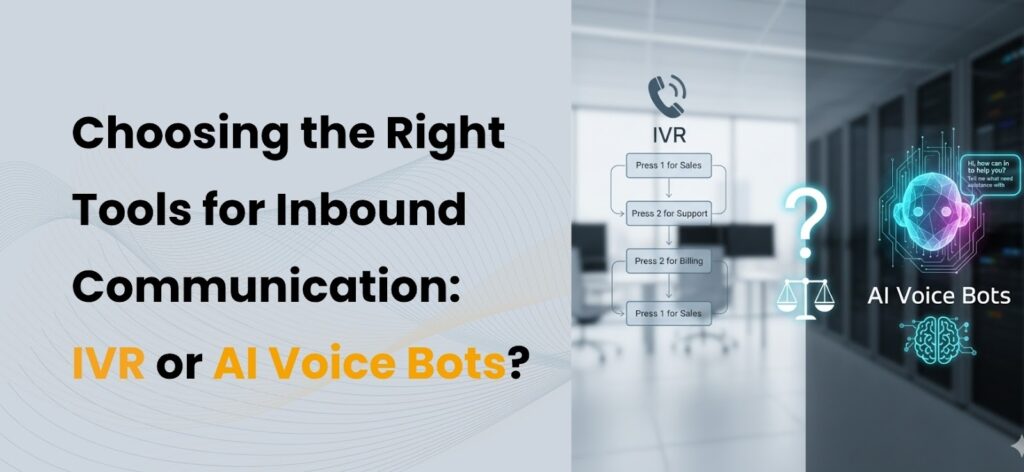
IVR systems and AI voice bots have emerged as essential tools to address these challenges. How can IVR ensure that callers reach the right department quickly and automate routine queries? How can AI voice bots engage in natural conversations, understand complex requests, and provide real-time responses?
The key is not choosing one over the other. Successful businesses use IVR and AI voice bots together, applying each where it fits best. Understanding how to balance structure with flexibility is crucial for creating inbound communication that works for both the customer and the organization.
What IVR Systems Offer
How often do customers get frustrated when a call takes too long to reach the right department? This is where IVR systems provide tangible value. Interactive Voice Response, or IVR, acts as the first point of organization for inbound calls, guiding each caller to the appropriate channel quickly and efficiently.
IVR excels at handling predictable, structured interactions. It can verify account details, route calls based on issue type, or provide answers to frequently asked questions without involving a live agent. For example, a bank can use IVR to authenticate a caller and route them to the right service representative, while a healthcare provider can automate appointment scheduling and basic patient queries. These processes not only reduce wait times but also free human agents to focus on complex issues that require judgment and empathy.
Modern IVR systems go beyond simple menus. Successful integration with CRM tools helps in contextual insights before the customer conversation, helping the calling agents to give informed and personalized interactions. Choosing a reliable IVR service providers guarantees the system aligns with your business processes and delivers a seamless experience for customers.
What AI Voice Bots Offer
What happens when a customer has a query which cannot fit into a structured menu? This is where AI voice bots bring significant value. Unlike IVR, AI voice bots provide adaptive, human-like conversational support that can handle nuanced questions, interpret intent, and respond in real time, with solutions like Voxify AI enhancing these interactions by converting written responses into human-sounding voice-overs using AI-based speech synthesis technology.
These bots excel in scenarios where conversations are dynamic or require context. For instance, a retail company can use an AI voice bot to help a customer navigate through product selection, check delivery status, or assist with returns, all through a natural, human-like conversation. Similarly, it is being rapidly deployed in diverse industry use cases such as sales, support and many more.
AI voice bots learn from each interaction, improving their responses over time. This ensures that the communication system becomes more accurate and efficient with continued use, providing businesses with both operational efficiency and elevated customer satisfaction. Collaborating with reputableAI voice bot companies allows organizations to customize workflows, integrate with existing CRM systems, and maintain a consistent, high-quality customer experience across all inbound interactions. In many cases, this customization is enabled through a whitelabel AI agent builder, allowing businesses to tailor conversational logic, branding, and integrations without rebuilding voice intelligence from scratch.
How IVR and AI Voice Bots Work Together
Businesses can be more efficient without sacrificing customer quality or adding staff by using a business phone system with IVR and AI voice bots. Each tool handles unique inbound communication needs, and together they create a smooth, integrated experience.
IVR excels at preliminary call management. It ensures that calls are routed to the right agent or department, through a Salesforce IVR Integration, collects basic information, and automates routine tasks. AI voice bots are more capable of handling the dynamic, conversational aspects of customer inquiries. They can interpret intent, answer complex questions, and escalate only the interactions that require human judgment.
Consider a telecom company managing thousands of inbound calls daily. IVR can quickly sort calls based on the caller’s requirement to the relevant agent or department. Once routed, an AI voice bot can interact with the caller to troubleshoot technical problems, schedule technician visits, or answer policy-related questions. Through this, calls with complex issues requiring human intervention will only reach human agents, reducing wait times and agent workload.
By designing a hybrid workflow that brings the strengths of both IVR and AI voice bots, organizations can create an inbound communication system that is efficient and customer-centric.
Key Factors in Choosing the Right Tool
What factors will an enterprise consider before deciding on an inbound communication tool? Who should rely on IVR? Is a voice bot helpful for large enterprises? Will a combination of both work? One major factor in this decision is the total cost of ownership; for instance, teams looking to optimise their budget might seek out an Intercom discount or similar SaaS incentives to integrate premium chat and automation tools without overextending their financial resources. The answer depends on operational requirements, budget scale, customer expectations, and technological capabilities.
Call volume and complexity should be the initial consideration. High-volume, repetitive inquiries are ideal for IVR, which can handle routing and standard requests efficiently. Complex, unpredictable interactions benefit from AI voice bots that can interpret intent, provide contextual answers, and adapt to conversation flow.
Customer experience priorities also play a decisive role. If speed and accuracy are paramount, IVR ensures that calls are directed without delay. If personalization and conversational engagement are the goals, AI voice bots can provide human-like interactions that enhance satisfaction.
Integration capabilities are equally important. Partnering with cloud telephony service providers allows businesses to connect IVR and AI bots seamlessly with CRM, ticketing, and analytics systems. This ensures that customer information flows uninterrupted and agents are fully informed when interactions escalate.
Other essential factors are:
- Scalability
- Flexibility
- Vendor expertise
Collaborating with a trusted IVR solution provider or AI voice bot company guarantees that the technology goes well with both business goals and customer expectations.
Conclusion
IVR systems and AI voice bots are not competing solutions but complementary tools if we implement them strategically. IVR provides structure, efficiency, and predictability, while AI voice bots add adaptability, conversational intelligence, and contextual understanding.
The key is to assess your business needs carefully, considering call volume, complexity, customer experience goals, and integration capabilities. By leveraging both technologies thoughtfully, businesses can decrease wait times, improve first-call resolution rates, and deliver a satisfying experience to every caller, turning inbound communication from a routine process into a strategic advantage.