
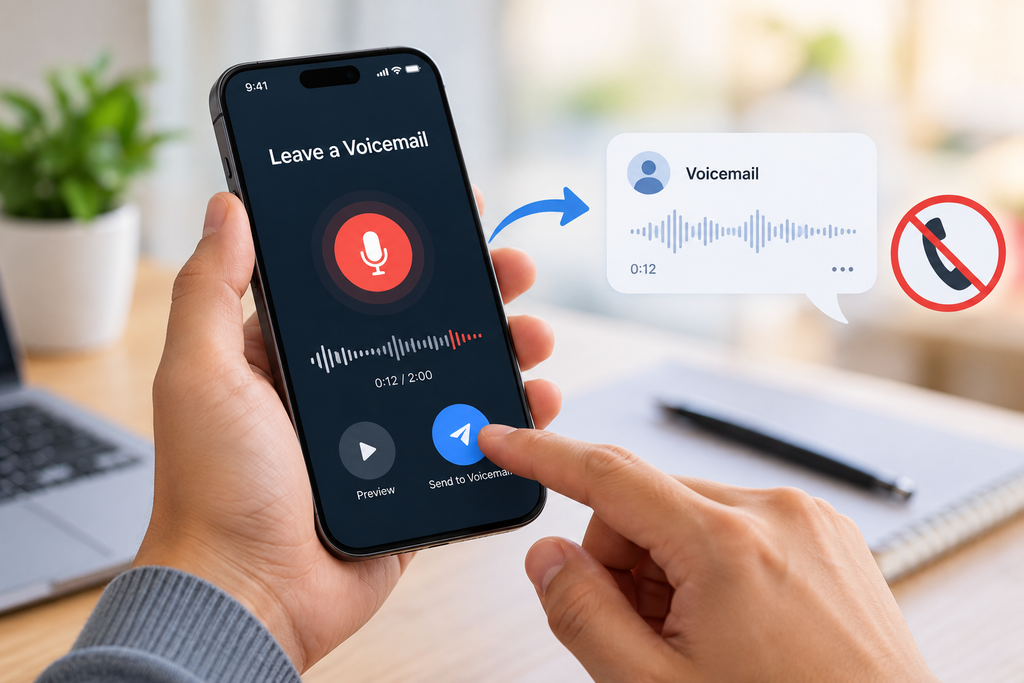
You can sometimes send a message straight to someone’s voicemail inbox without ringing their phone. This guide shows the available methods, what to do on iPhone and Android, and why delivery is not always guaranteed.
Introduction
Yes, you can sometimes leave a voicemail without ringing someone’s phone. Your carrier’s voicemail system may let you record and send a message to another subscriber, or a direct-to-voicemail service may deliver it to the recipient’s voicemail inbox. Neither route works for every number, so don’t assume the message arrived.
The key distinction is between avoiding a conversation and avoiding a ring: calling someone and waiting for voicemail does the first, but not the second. A direct-to-voicemail message aims to bypass the ring altogether. What works depends on the sender’s service, the recipient’s carrier, and how that person’s voicemail is set up—not simply on whether they use an iPhone or Android phone. If the message is important, follow up through another channel rather than treating an attempted voicemail drop as proof of delivery.
Key Findings
- Check your carrier’s voicemail menu first for a send-message option, the most direct route when available.
- A compatible direct-to-voicemail service may reach a mobile inbox, but ringing is still possible with some methods.
- An iPhone or Android phone does not by itself enable voicemail delivery without ringing.
- Mobile-focused services may not support landlines, and every method requires a compatible, active voicemail inbox.
- A service accepting your recording does not prove the recipient received it; follow up through another channel if confirmation matters.
How to Leave a Voicemail Without Calling: Step by Step
- Confirm the recipient has an active voicemail inbox and identify whether the number is mobile or landline.
2. Check your carrier’s voicemail menu for a send-message option; prompts, access codes, and supported destinations vary, and *86 does not universally send messages.
3. On iPhone, check the Phone app’s Voicemail tab or your carrier’s voicemail menu;
4. on Android, check the Phone app’s voicemail interface or dial your carrier’s voicemail access number, then follow any send-message prompts.
5. If that option is unavailable, Slydial uses an intermediary call flow for supported mobile numbers, not your carrier’s send-message feature; ringing is still possible.
6. Alternatively, a ringless voicemail service can deposit a recording if the carrier and inbox support it, though notifications and consent requirements may apply.
7. For a landline, check for provider-supported voicemail messaging; mobile-focused services may not work.
8. Check for acceptance or delivery confirmation: an attempted send does not prove receipt.
What You Need Before Sending a Voicemail Directly
You need the recipient’s correct phone number, an active voicemail inbox that can accept messages, and a delivery method that supports that destination. Carrier voicemail systems may restrict sending to certain networks or subscribers, while direct-to-voicemail services may support some mobile numbers but not landlines; a landline answering machine is not necessarily a compatible voicemail inbox. Check the carrier’s send-message feature or the service’s number and carrier compatibility before recording, rather than assuming an iPhone or Android number will work. For a personal message, make sure the recipient welcomes contact; business outreach and automated messages may face additional consent and privacy rules, so do not treat direct delivery as a way around them.
Why a Direct-to-Voicemail Message Might Not Arrive
A direct-to-voicemail message can fail if the destination is unsupported, the recipient’s inbox cannot accept messages, or the carrier filters the delivery attempt. Check the number first: a mistyped digit can send the recording elsewhere, and some methods do not work with landlines or certain carriers. An inactive or full inbox can also prevent delivery; if the message is not immediately visible, allow for a possible delay before trying again. A service accepting your recording confirms only that it received your submission, not that the recipient received the voicemail. Even when ringless voicemail delivery succeeds, the recipient may still get a voicemail notification; if confirmation matters, contact them through another appropriate channel.
Conclusion
To leave a voicemail without calling the recipient, start with your carrier’s voicemail menu: a send-message option, if available, is the most direct route. Otherwise, a compatible direct-to-voicemail service may let you send a voicemail directly to a mobile inbox, but using an iPhone or Android phone does not by itself enable voicemail without ringing, and landline destinations may not be supported. Before sending, confirm that the method supports the recipient’s number; afterward, check any delivery status separately from whether the recipient received a notification. If the message matters urgently, use another way to contact them rather than treating a submitted recording as proof they heard it.
Frequently Asked Questions
Can a voicemail be left without a call?
Yes, some methods can place a message in someone’s voicemail inbox without ringing their phone. A carrier voicemail connection or direct-to-voicemail service may still handle the delivery. “Without calling” means the recipient does not receive a conventional ringing call, not that no call-related process takes place.
What does *86 do on a phone?
*86 commonly connects you to your own carrier voicemail system so you can listen to messages or manage your inbox. It is not a universal code for leaving a message in someone else’s voicemail. Access codes vary by carrier, so check your carrier’s instructions if *86 does not work.
Can I hear someone else’s voicemail without calling them?
No, leaving someone a voicemail does not let you hear the messages in their inbox. Listening to another person’s voicemail requires their authorization and access through their voicemail provider. Direct-to-voicemail methods deliver a message; they do not grant access to messages the recipient has received.
Can I leave a voicemail on a landline without ringing it?
Sometimes, but the landline must have an active voicemail inbox and its provider must support a compatible messaging method. Many direct-to-voicemail services are designed for mobile numbers and may not work with landlines. Check the landline provider’s instructions rather than assuming a mobile method will work.
Will the recipient know I left a voicemail?
They may. Even if their phone never rings, a new message can appear in their voicemail inbox or trigger a notification. What they see depends on their carrier, device settings, and how the message was delivered. Direct delivery should not be treated as anonymous or invisible.
What happens if the recipient has no voicemail box?
A direct-to-voicemail message generally cannot be delivered if the recipient has no active voicemail inbox. The carrier or service may reject the attempt, and submitting a message does not by itself confirm delivery. If the message matters, use another appropriate way to contact the person.